
Liberation Dispatch 010: Why Your Job Will Never Save You
And How to Redirect Your Energy Towards What Will

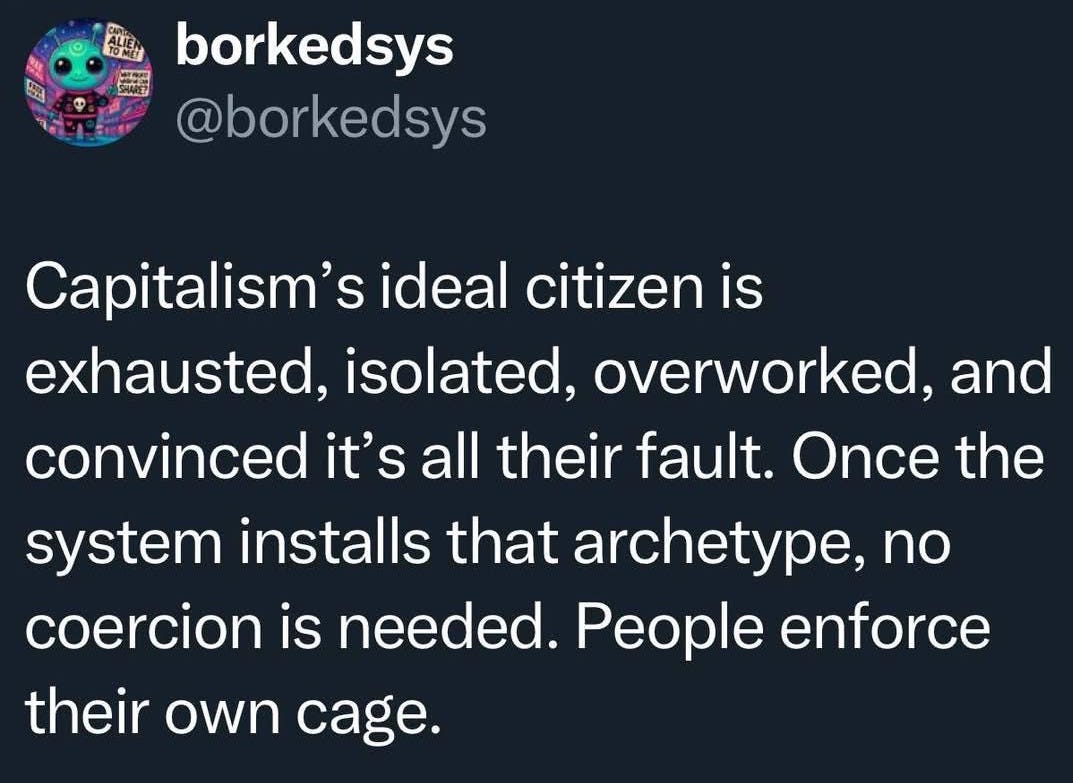
A lot of people are scared right now.
Scared of the job market. Housing market. The rise of fascism, etc.
There’s no shortage of reasons to be afraid.
However, if you stay in this fear, that will inevitably lead to inaction, and that inaction is exactly what the system relies on. When we stay afraid, we stay obedient. When we stay anxious, we stay distracted. When we stay frozen, nothing changes.
This fear and anxiety causes us to fall into comfortable patterns. Patterns that have kept us safe and stable in the past.
For some, the fear I mentioned earlier is alleviated when they think to themselves: “at least I have a job”. Or “certainly, when I get a job or a better paying job, things will get easier.”
But here’s the troubling truth: your job is not going to save you.
Chances are, your boss doesn’t really care about you. Your wellbeing. Your future. Whether your bills get paid on time or if you’re struggling to make ends meet.
Your boss can let you go at any time, for just about any reason. And, if you’re like most of the population, you live paycheck-to-paycheck and don’t have a safety net to support you if such a situation were to occur.
You can allow that truth to terrify you OR you can allow it to liberate you from the expectation to be loyal to people, organizations, or systems that do not give back to you or positively contribute to your future.
The most viable way forward for all of us will require you to individually divest from the systems that are the root cause of the fears and anxieties. And I’m not just talking about financial divestment. I’m talking about divesting in all the forms that keeps the machine running: your energy, your attention, your finances, and most importantly, your values.
The Myth of Job Security
Most likely, you were promised that if you complied, got the degree, acquired the credentials, secured the job in a “recession proof” field and remained loyal to your employer, that you’d be rewarded with the economic mobility afforded to your parents and grandparents who did the same.
The white picket fence. A home in a “good” neighborhood. Secure retirement prospects. Multiple family cars so you can easily get your people to and from wherever they needed to be.
The reality? Wage stagnation. Rising housing costs. Skyrocketing food costs. And a sinking feeling that you’re constantly falling behind your peers.
The hard truth is that by continuing to align yourself (mentally, emotionally, financially) with these extractive, exploitive systems, you are contributing to the deterioration of not only your own well-being, but also the well-being of those who are the most vulnerable.
We live in capitalism. Its power seems inescapable. So did the divine right of kings… Any human power can be resisted and changed by human beings. - Ursula K. Le Guin
As more people opt out of these systems and reimagine life and work rooted in autonomy, solidarity, joy, and collective alignment, the closer we all get to realizing that vision.
Capitalism & White Supremacy Interlock
Now, I’m going to say the quiet part out loud. All of these Dispatches have been focusing on the same subject: how to undo the mental conditioning we all have received living in a capitalist society that is upheld by white supremacy.
Some of the features of this capitalist culture include:
Prioritizing profit over people
Wealth extraction from the most vulnerable and disenfranchised communities, especially the Black community
Competition being valued over cooperation
The endless accumulation of wealth, or the desire to endlessly accumulate wealth just for the sake of it
These values, while not exhaustive, are guaranteed to show up in every workplace and in every aspect of your personal life.
Similarly, some of the characteristics of white supremacy include:
A clear racialized hierarchy with Black people on the bottom and white people on top
Using fear as a strategy to manipulate and control the population
Perfectionism or believing there’s “one right way” to accomplish a goal
Denial and defensiveness against the ways racism and white supremacy are reproduced or impact the non-dominant population
Individualism, which goes hand-in-hand with valuing competition over cooperation
This list isn’t exhaustive. I encourage you to learn more about these characteristics on your own, if you feel inclined to do so.
Racism cannot be separated from capitalism. - Angela Y. Davis
These two systems, capitalism and white supremacy, reinforce one another. Labor extraction and exploitation, especially from Black populations, has been a distinct feature of capitalism since its development.
The enslaving of Africans led to the accumulation of vast amounts of wealth, specifically and primarily for white, or European, individuals.
Since slavery has been abolished, there have been several systems, including sharecropping, redlining, and racist discrimination in the labor market (just to name a few) that have been intentionally designed to keep Black people in the most exploited, lowest-paid positions and circumstances.
Reports from the Federal Reserve indicate that the median white family holds 8 - 10 times more wealth than the median Black family.
This system works both ways as capitalism benefits from cheap, coerced, racialized labor that is justified by anti-Black racism, while this racial hierarchy reinforces the economic structures that keep wealth and power concentrated mostly in the hands of a few, primarily white, people.
When we include ability, gender, and sexuality into this equation, things get even messier.
All of this is upheld by the myth that “success” reflects individual talent and effort in a fair system. This myth of meritocracy obscures how inherited advantages across generations and structural barriers to access necessary resources such as housing, schooling, and even food are all primarily based on race or one’s proximity to whiteness.
Internalized Capitalism + Internalized Racism
Regardless of your race or background, your self-worth, fears, anxieties, imposter syndrome, and feelings of inadequacy have all stemmed from or been shaped by this interlocking racist-capitalist system.
This destructive mindset is formed due to the internalization of both capitalist and racist values.
Internalized capitalism shows up when you adopt capitalist values as your own, even and specifically when it is to your detriment to do so. You may be perpetuating a capitalist mindset if you:
Feel guilty when you rest,
Prioritize work over your well-being,
Tie your self-worth directly to your productivity,
Believe hard work alone will lead to your happiness, or
Feel like you must constantly be busy to have value
On the other hand, internalized racism shows up as Internalized Racial Oppression.
For members of the African diaspora and the communities who struggle against the racist, colonial power structure, Internalized Racial Inferiority actively undermines our ability to thrive and build collective power.
Internalized racism makes us doubt our own voice, convinces us that leadership is not for us, and causes us to self-sabotage by shrinking ourselves and avoiding opportunities because we’ve internalized the lie that others won’t want us there.
Sadly, it can even cause us to turn against our own community by competing for scraps of approval from the dominant group or tearing down those of us who do succeed.
This Internalized Racial Inferiority makes collective organizing feel impossible by fostering infighting and convincing the next generation that liberation is unrealistic, which prevents them from fully engaging in efforts toward change.
The cost of this internalized lie is that we will remain isolated from our own power, both individually and collectively, and will stay trapped performing someone else’s limited idea of who we can be while the systems that created these lies continue to thrive unchallenged.
For those part of the dominant group, Internalized Racial Oppression shows up as Internalized Racial Superiority. It teaches white people that their comfort is more important than growth, leading them to avoid the discomfort that can lead to deeper understanding. Internalized Racial Superiority also demands perfection over learning, causing white people to be defensive and overly fragile about inevitable mistakes. Additionally, this superiority complex prioritizes thinking over feeling, further disconnecting the dominant group from their humanity by diminishing empathy and the importance of authentic relationships.
White people and those from the dominant group are more likely to be trapped in isolation due to the belief that they must succeed alone rather than through and with community. Internalized Racial Superiority burdens them with paternalism, making it seem as if they are responsible for “saving” others, rather than building solidarity and reciprocal relationships with those around them. It forces silence when they witness harm, eroding their integrity and making them complicit in the damage caused by the racial-capitalist system.
Those who live their lives through this lens often remain emotionally immature and unstable as well as spiritually incomplete. They tend to defend a false version of reality rather than experiencing the full richness of human connection. This is dehumanization, and it is harmful to white people or those who align themselves with whiteness.
Individual Divestment
Individual divestment from these systems requires more than a declaration that you are “opting out”. It requires an internal shift in your values and principles. Because when you subconsciously live your life by the capitalist and white supremacist characteristics listed above, you are actively contributing to the normalization of this culture.
From an individual perspective, divestment might look like:
Setting and reinforcing boundaries at work to preserve as much of your time and energy as possible
Investing in personal relationships (platonic, romantic, etc) that are mutually beneficial
Committing to consuming less overall (e.g. upcycling vs buying new)
Replacing doomscrolling with a creative outlet or volunteering in your community
Viewing rest as your natural right, instead of something that must be earned
If you are looking to analyze where your values currently align, in Dispatch 03 there’s a 5-question Success Audit that one can use to determine if their values are more closely aligned with metrics based on capitalism or liberation.
Individual divestment is the bedrock for systemic change. Once you stop performing as expected and begin modeling new possibilities, you become a blueprint for others to follow.
At first, you may think these suggestions are risky or difficult to implement. You may fear that you’ll lose your job or access to income. Or that you may be perceived as a failure or lose the approval of those you care about.
The good news is that this fear is manufactured. This fear is what keeps most of us trapped in this way of thinking and behaving.
The most likely outcome of you implementing some or all of the suggestions listed (or coming up with your own divestment strategies!) is more internal peace, joy, and a lifestyle rooted in rest and liberation.
When even one person shifts their way of thinking and being, it impacts their community, workplace, and their relationships in a domino-like effect.
Instead of reinforcing individualism, when you live a Liberated Lifestyle, you are also actively normalizing a culture of collective liberation.
This opens up a space for a shared imagination for new ways of being, rather than simply reacting as expected to an inherited system.
The type of lifestyle I’m describing is one with freedom of time, personal and collective autonomy, mental clarity, creative expression as a right instead of a privilege, meaningful and mindful connection, and work that is necessary and mutually beneficial.
Community as the Real Safety Net
Once you start walking down the path of living a Liberated Lifestyle, then you will have the opportunity to start calling in your community. A liberated community that is rooted in rest culture and collective success.
We are the leaders we’ve been looking for. - Grace Lee Boggs
What most of us hope to attain from accumulating wealth is actually best achieved by growing and strengthening our community.
While it is commonly believed that more money guarantees security, freedom of choice, a sense of belonging, status, and a lasting legacy, it’s actually a strong, interconnected community that delivers each of these more reliably and completely.
A strongly bonded community creates safety nets through the form of mutual aid. Freedom of choice is increased for everyone when communities share skills, tools, childcare responsibilities, and knowledge.
Contributing to one’s community also increases one’s status and allows one to form genuine connections, as opposed to buying admiration from others.
We pursue individual wealth to purchase what healthy communities provide collectively. In doing so, we actively erode the very communities that would better deliver what we’re seeking.
Structural Barriers & Pushback
Let me set one thing straight: there are real structural barriers that exist that make divestment from these extractive systems varyingly difficult depending on individual circumstances.
Among them are economic instability, debt, institutional gatekeeping, racism, ableism, and gendered dynamics, but these are just to name a few.
In addition to these structural barriers, there are also internal barriers, especially an internalized scarcity mindset that may prevent one from divestment. The system will attempt to push back when you begin divesting. This pushback may come in the form of pressure from family and friends, backlash at work, or an initial ostracization from your community.
An unwavering belief in yourself, in our community, and what we are building towards will be paramount in the face of these challenges. You will naturally establish a new community and support structures that will aid you in your liberation journey.
Divestment Isn’t Just Survival — It’s How We Win
You are allowed to redefine success on your own terms. You are allowed to rest and to reframe your mindset to be centered around joy and collective freedom.
When you divest, you undermine the machine and actively become part of the movement you long for.
While a job will never save you, your community always will.
Hope is a discipline. - Mariame Kaba
If you’re wondering how you can best support your community today while divesting from extractive systems, I would suggest learning or teaching a self-sufficient skill. How to use a sewing machine. Or gardening. Or jarring and pickling goods or making soap and cleaning products.
Learn a practical, hands-on skill that can be utilized for collective care, mutual aid, and economic independence from the machine.
Think of each skill acquired or shared as another domino falling or another bolt being disassembled from the unsustainable structure.
Your job will never save you because it was never designed to, but divesting from the systems that keep you afraid, exhausted, and obedient is the first step toward reclaiming your power, your community, and your liberation.
Until next time,
Char, the Afrocommunist.